
JB GERMAN OIL GmbH
Wölzower Weg 27
19243 Wittenburg
Phone: +49 (0) 38852 – 90620
Fax: +49 (0) 38852 – 906220
Email: info@jb-germanoil.de
Jürgen Baumgarten
Managing Director
+49 38852 90620
j.baumgarten@jb-germanoil.de
Thomas Arndt
Managing Director
+49 38852 90620
t.arndt@jb-germanoil.de
Hanno-David Alberts
Managing Director
+49 38852 90620
hd.alberts@jb-germanoil.de
Sandra Pietzner
Authorized Signatory
+49 38852 906222
s.pietzner@jb-germanoil.de
Svetlana Höhne
Export Sales Manager
+49 38852 906221
s.hoehne@jb-germanoil.de
Ireen Efler
Domestic Sales / OIL! Gas Stations
+49 38852 906215
i.efler@jb-germanoil.de
JB GERMANOIL Lubricants Made in Germany – Quality That Moves the World
Since its founding in 1997, JB GERMAN OIL GmbH has earned the trust of countless customers in over 51 countries worldwide. With expertise, reliable service, fair pricing, and strong customer orientation, the company has established itself as a key player in the lubricant market. Over 6,500 tons of high-tech lubricants are produced and distributed annually – a testament to performance and quality. Private-label products with customized company logos further enhance brand identity and recognition for our partners.
At the Wittenburg site, located directly on the A24, JB GERMAN OIL operates an 80,000 m² company facility with office and warehouse complexes. More than 800,000 liters of lubricants in all common packaging units are available there – ready for any application. The product range extends from engine and transmission oils to hydraulic fluids, greases, 2-wheel products, service items, and winter chemicals. Thanks to optimal logistics connections, nationwide shipping is carried out daily via DPD and Schenker, as well as container loading through the Port of Hamburg.
Our philosophy is clear: becoming better every day – for the benefit of our customers and partners. Strong distribution partners worldwide help carry forward the quality and reliability of JB GERMAN OIL.
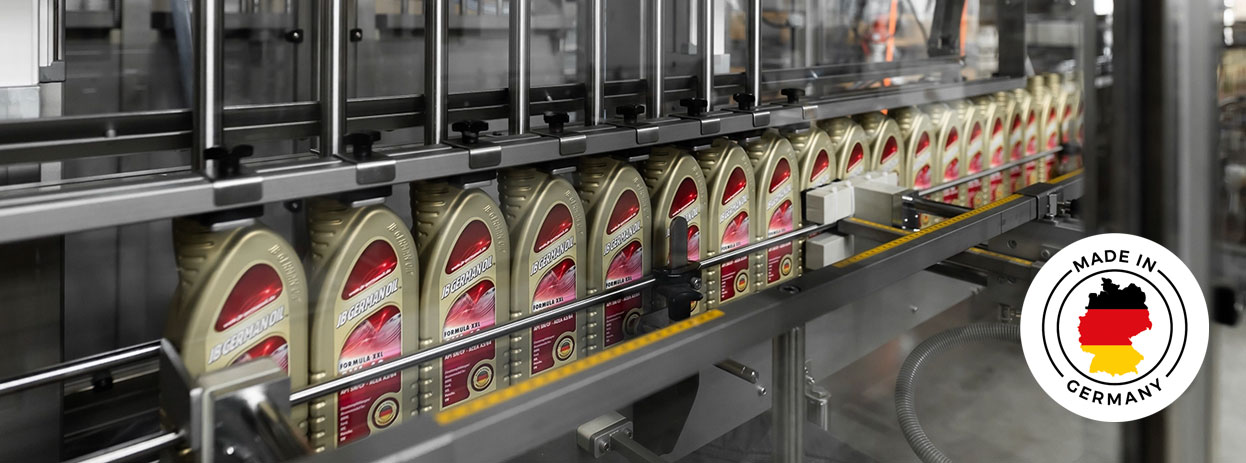
Our highly specialized system enables the efficient and precise filling of engine oil into bottles, canisters, or other packaging containers. It ensures that each container receives the exact amount of engine oil required to meet strict quality standards. With state-of-the-art technology, precise dosing pumps, and advanced control systems, the filling plant is capable of achieving high production capacity while maintaining minimal waste rates. This not only ensures product quality but also significantly improves the efficiency and profitability of the production processes.
Driven by Passion for Motorsports – The Force Behind JB GERMAN OIL

Jürgen Baumgarten – Motorsport as the Driving Force Behind Peak Performance
Jürgen Baumgarten, founder of JB GERMAN OIL GmbH in Wittenburg near Hamburg, is one of Germany’s most successful international motocross riders. His numerous national and international achievements on two wheels earned worldwide recognition and shaped his high standards for technology, performance, and precision.
More than 40 years in international motorsports regularly pushed both man and machine to their limits. These intensive experiences with extreme engine and transmission demands inspired Jürgen Baumgarten to collaborate with engineers and chemists to develop lubricants capable of delivering maximum performance even under the harshest conditions. Decades of motorsport knowledge flow directly into the development of JB GERMAN OIL products.
The result is lubricants that combine cutting-edge technology with the highest quality and reliability. Numerous international certifications and approvals from renowned automobile manufacturers confirm this top-tier quality. Today, the name Jürgen Baumgarten stands not only for a passion for motorsports, but also for innovation, technical expertise, and uncompromising quality – qualities that make JB GERMAN OIL a valued partner in the global lubricant industry.
From Engine Oils to Industrial Lubricants – Discover Our Complete Product Range
Technical Specifications and Oil Classifications at a Glance
Three main factors specifically influence the European market:
- extended oil change intervals
- fuel savings
- exhaust emission composition
The different application areas of engine oils are identified in the European ACEA 2012 classification by letters:
- A/B for passenger car gasoline & diesel engines
- C for passenger cars with diesel particulate filters
- E for commercial vehicle diesel engines
| A1/B1 | Shear-stable “STAY in GRADE” oils for use in passenger car gasoline engines and light van diesel engines with extended oil change intervals. Specially developed low-friction oils with very low viscosity and a high-temperature/high-shear viscosity of 2.6 mPa*s for xW/20 and 2.9–3.5 mPa*s for all other viscosity grades. These oils may not be suitable for certain vehicle engines. Consult vehicle manuals or dealers if unsure. Special manufacturer approval required. |
| A3/B3 | Shear-stable “STAY in GRADE” oils for use in high-performance gasoline and diesel engines and light van diesel engines and/or for extended oil change intervals as specified by engine manufacturers and/or for year-round use of low-viscosity oils and/or for severe operating conditions defined by engine manufacturers. |
| A3/B4 | Shear-stable “STAY in GRADE” oils recommended for use in high-quality gasoline engines and direct-injection diesel engines, but also suitable for the applications described under A3/B3. |
| A5/B5 | Shear-stable “STAY in GRADE” oils for use in high-performance gasoline and diesel engines and light van diesel engines with extended oil change intervals. Developed to enable the use of low-friction, low-viscosity oils with high-temperature/high-shear stability (HTHS) of 2.9–3.5 mPa*s. These oils may not be suitable for certain vehicle engines. Consult vehicle manuals or dealers if unsure. Special manufacturer approval required. |
| C1 | Shear-stable “STAY in GRADE” oils for use as catalyst-compatible oils in vehicles with DPF and TWC in high-performance passenger cars and light van diesel and gasoline engines. These are low-friction oils with low viscosity and low SAPS values, featuring a minimum HTHS viscosity of 2.9 mPa*s. These oils help extend the service life of DPF and TWC and improve fuel economy. They have the lowest SAPS limit and may not be suitable for certain engines. Consult vehicle manuals or dealers if unsure. Special manufacturer approval required. |
| C2 | Shear-stable “STAY in GRADE” oils for use as catalyst-compatible oils in vehicles with DPF and TWC in high-performance passenger cars and light van diesel and gasoline engines. These low-friction oils feature low viscosity and a minimum HTHS viscosity of 2.9 mPa*s. They help extend the life of DPF and TWC and save fuel. These oils may not be suitable for certain engines. Consult vehicle manuals or dealers if unsure. Special manufacturer approval required. |
| C3 | Shear-stable “STAY in GRADE” oils for use as catalyst-compatible oils in vehicles with DPF and TWC in high-performance passenger cars and light van diesel and gasoline engines, featuring a minimum HTHS viscosity of 3.5 mPa*s. These oils help extend the service life of DPF and TWC. They may not be suitable for some engines. Consult vehicle manuals or dealers if unsure. Special manufacturer approval required. |
| C4 | Shear-stable “STAY in GRADE” oils for use as catalyst-compatible oils in vehicles with DPF and TWC in high-performance passenger cars and light van diesel and gasoline engines. These oils offer low SAPS values and a minimum HTHS viscosity of 3.5 mPa*s. They help extend the service life of DPF and TWC. These oils may not be suitable for some engines. Consult vehicle manuals or dealers if unsure. Special manufacturer approval required. |
| E4 | Shear-stable “STAY in GRADE” oils that guarantee excellent piston cleanliness, wear protection, efficient prevention of soot deposits, and stable lubrication. Recommended for use in heavy-duty high-performance diesel engines that meet Euro I, Euro II, Euro III, Euro IV, and Euro V emission standards under very demanding conditions. Extremely long service intervals are possible depending on manufacturer specifications. These oils are designed for engines without particulate filters and for some EGR engines and some engines with SCR NOx reduction systems. Manufacturer recommendations may vary. Consult vehicle manuals or dealers if unsure. Special manufacturer approval required. |
| E6 | Shear-stable “STAY in GRADE” oils that guarantee excellent piston cleanliness, wear protection, efficient prevention of soot deposits, and stable lubrication. Recommended for use in heavy-duty high-performance diesel engines that meet Euro I, Euro II, Euro III, Euro IV, Euro V, and Euro VI emission standards under very demanding conditions. Extremely long service intervals are possible depending on manufacturer specifications. These oils are designed for EGR engines with or without particulate filters and for engines with SCR NOx reduction systems. E6 is required for engines equipped with particulate filters and was developed for use with low-sulfur fuels. Manufacturer recommendations may vary. Consult vehicle manuals or dealers if unsure. Special manufacturer approval required. |
| E7 | Shear-stable “STAY in GRADE” oils that ensure piston cleanliness and prevent bore polishing. They also offer high wear protection, low turbocharger deposits, and stable lubrication. Recommended for use in heavy-duty high-performance diesel engines that meet Euro I, Euro II, Euro III, Euro IV, and Euro V emission standards under very demanding conditions. Extremely long service intervals are possible depending on manufacturer specifications. These oils are designed for engines without particulate filters, most EGR engines, and most engines with SCR NOx reduction systems. Manufacturer recommendations may vary. Consult vehicle manuals or dealers if unsure. Special manufacturer approval required. |
| E9 | Shear-stable “STAY in GRADE” oils that ensure piston cleanliness and prevent bore polishing. They also offer high wear protection, low turbocharger deposits, and stable lubrication. Recommended for use in heavy-duty high-performance diesel engines that meet Euro I, Euro II, Euro III, Euro IV, Euro V, and Euro VI emission standards under very demanding conditions. Extremely long service intervals are possible depending on manufacturer specifications. These oils are designed for engines with or without particulate filters, most EGR engines, and most engines with SCR NOx reduction systems. E9 is required for engines equipped with particulate filters and was developed for use with low-sulfur fuels. Manufacturer recommendations may vary. Consult vehicle manuals or dealers if unsure. Special manufacture |
Handbook for Engine Oils
1. Performance Level:
Gasoline engine oil categories (for passenger cars, vans, and light trucks such as Sprinters with gasoline engines): Oils developed for gasoline engines are classified under API “S” (Service) categories. See the description of current and obsolete API Service Categories.
Diesel engine oil categories (for heavy-duty trucks and diesel-powered vehicles): Oils developed for diesel engines are classified under API “C” (Commercial) categories. See the description of current and obsolete API Service Categories.
2. Viscosity Grade:
This is a measure of thickness and flow characteristics at specific temperatures. Vehicle requirements may vary. Manufacturer recommendations regarding the prescribed SAE viscosity grade must be followed.
3. Energy Conservation:
The designations “Resource Conserving” and “Energy Conserving” apply to gasoline-powered passenger cars, vans, and light-duty vehicles. Widespread use of these oils can contribute to overall fuel savings across an entire vehicle fleet.
4. Multiple Performance Levels:
Lubricants developed for diesel engines may also be suitable for gasoline engines in some cases. For such oils, the “C” category is listed first, followed by the “S” category. “C” category oils were originally developed for diesel engines and therefore may not meet all requirements that vehicle manufacturers specify for gasoline engine lubricants.
Multigrade oils such as SAE 5W-30 and 10W-30 are widely used because they are thin enough to remain fluid at low temperatures and thick enough to provide reliable performance at high temperatures. It is important to note that vehicle requirements may vary.
The valid and previous API classifications are listed here. Vehicle owners should check the information in their owner’s manual before consulting these details. Engine oils may have more than one performance level. For gasoline engines, the newest API class includes the requirements of all previous ones. If a vehicle’s manual recommends an oil with API SJ or SL, an API SM oil can provide full protection. For diesel engines, the latest category usually—but not always—includes the performance requirements of earlier categories.
| Lowest Expected Outside Temperature: | Typical SAE Viscosity for Passenger Car Engine Oils: |
| 0°C (32°F) | 0W-20 0W-30 5W-20 5W-30 10W-30 10W-40 20W-50 |
| –18°C (0°F) | 0W-20 0W-30 5W-20 5W-30 10W-30 10W-40 |
| Below –18°C (0°F) | 0W-20 0W-30 5W-20 5W-30 |
| SN | Valid
Introduced in 2010, SN oils provide improved high-temperature protection against piston deposits and offer enhanced seal compatibility. API SN oils labeled “Resource Conserving” meet ILSAC GF-5 specifications and are characterized by improved fuel economy, turbocharger protection, and emissions system compatibility. They also protect engines using ethanol-containing fuels up to E85. |
| SM | Valid
For vehicle engines from 2010 and earlier. |
| SL | Valid
For vehicle engines from 2004 and earlier. |
| SJ | Valid
For vehicle engines from 2001 and earlier. |
| SH | Obsolete
For vehicle engines from 1996 and earlier. |
| SG | Obsolete
WARNING: Not suitable for gasoline engines built after 1993. May not provide adequate deposit protection. |
| SF | Obsolete
WARNING: Not suitable for gasoline engines built after 1988. May not provide adequate deposit protection. |
| SE | Obsolete
WARNING: Not suitable for gasoline engines built after 1979. |
| SD | Obsolete
WARNING: Not suitable for gasoline engines built after 1971. Use in modern engines may result in insufficient performance or damage. |
| SC | Obsolete
WARNING: Not suitable for gasoline engines built after 1967. Use in modern engines may result in insufficient performance or damage. |
| SB | Obsolete
WARNING: Not suitable for gasoline engines built after 1951. Use in modern engines may result in insufficient performance or damage. |
| SA | Obsolete
WARNING: Contains no additives. Not suitable for gasoline engines built after 1930. Use in modern engines may result in insufficient performance or damage. |
| FA-4 | Valid
Describes certain XW-30 oils specifically developed for use in selected high-speed four-stroke diesel engines to meet greenhouse gas (GHG) emission limits for model year 2017 and newer. These oils are formulated for highway service using diesel fuel with a sulfur content of up to 15 ppm. Follow the engine manufacturer’s recommendations when using API FA-4 oils. API FA-4 oils are formulated with an HTHS range of 2.9 cP–3.2 cP to support GHG emission reduction. These oils are especially effective in maintaining emissions control systems where particulate filters and other modern aftertreatment technologies are used. API FA-4 oils are designed to provide enhanced protection against oxidation, shear-related viscosity loss, foaming, catalyst poisoning or clogging, particulate filter blockage, engine wear, piston deposits, loss of high- and low-temperature properties, and soot-related viscosity increase. API FA-4 oils are not interchangeable or backward-compatible with API CK-4, CJ-4, CI-4 with CI-4 PLUS, CI-4, or CH-4 oils. Consult manufacturer recommendations to determine whether API FA-4 oils are suitable. API FA-4 oils are not recommended for use with fuels containing more than 15 ppm sulfur. For fuels with higher sulfur content, follow vehicle manufacturer recommendations. |
| CK-4 | Valid
Describes oils developed for high-speed four-stroke diesel engines to meet emission requirements for model year 2017 under both on-highway and Tier 4 emission standards, as well as previous years. These oils are formulated for all applications using diesel fuels with up to 500 ppm sulfur. However, use with fuels exceeding 15 ppm sulfur may affect aftertreatment durability and/or oil drain intervals. API CK-4 oils are highly effective in maintaining emissions control systems where particulate filters and other advanced aftertreatment systems are used. They offer improved resistance to oxidation, shear-induced viscosity loss, foaming, catalyst poisoning or clogging, particulate filter blockage, engine wear, piston deposits, loss of high- and low-temperature properties, and soot-related viscosity increase. API CK-4 oils exceed the performance criteria of API CJ-4, CI-4 with CI-4 PLUS, CI-4, and CH-4 and can be used where these categories are specified. If CK-4 oils are used with fuels exceeding 15 ppm sulfur, consult the vehicle/engine manufacturer regarding oil drain intervals. |
| CJ-4 | Valid
Developed for high-speed four-stroke diesel engines to meet model year 2010 emission requirements under on-highway and Tier 4 standards, as well as earlier requirements. CJ-4 oils are designed for use with diesel fuels containing up to 500 ppm sulfur. However, use with fuels containing more than 15 ppm sulfur requires an emissions aftertreatment system and/or may shorten oil drain intervals. CJ-4 oils are highly effective with active emissions control systems using particulate filters and other preferred aftertreatment technologies. They provide excellent protection against catalyst poisoning, filter blockage, engine wear, piston deposits, thermal instability, soot buildup, oxidative thickening, foaming, and shear-induced viscosity loss. API CJ-4 oils exceed the requirements of API CI-4 with CI-4 PLUS, CI-4, CH-4, CG-4, and CF-4 and may be used where these categories are specified. When using CJ-4 oils with fuels containing more than 15 ppm sulfur, consult the vehicle manufacturer about oil drain intervals. |
| CI-4 | Valid
Introduced in 2002. Developed for high-speed four-stroke engines to meet 2004 emission standards introduced in 2002. CI-4 oils were formulated to ensure durability for engines equipped with exhaust gas recirculation (EGR) systems and are suitable for diesel fuels containing up to 0.5% sulfur. They may be used in place of API CD, CE, CF-4, CG-4, and CH-4 oils. Some CI-4 oils also qualify for the CI-4 PLUS specification. |
| CH-4 | Valid
Introduced in 1998. Designed for high-speed four-stroke engines built to meet 1998 emission standards. CH-4 oils are specifically formulated for use with diesel fuels containing up to 0.5% sulfur. They may be used in place of API CD, CE, CF-4, and CG-4 oils. |
| CG-4 | Obsolete
Introduced in 1995. For certain heavy-duty high-speed four-stroke engines operating on fuels with less than 0.5% sulfur. CG-4 oils were recommended for engines meeting 1994 emission standards. They may be used in place of API CD, CE, and CF-4 oils. |
| CF-4 | Obsolete
Introduced in 1990. For high-speed four-stroke, air-cooled engines and turbocharged engines. They may be used in place of CD and CE oils. |
| CF-2 | Obsolete
Introduced in 1994. For certain heavy-duty two-stroke engines. May be used in place of CD-II oils. |
| EC 1 | Minimum 1.5% fuel savings compared to an SAE 20W-30 reference oil in a 1982 Buick gasoline engine, 3.8 L, SEQ VI test. |
| EC II | Same as API EC 1, but with a minimum of 2.7% fuel savings. |
| EC | Replaces API EC 1 & EC II. Only applicable in combination with API SJ. Fuel savings: 0W-20, 5W-20 > 1.4%; 0W-XX, 5W-XX > 1.1%; 10W-XX, other grades > 0.5%; SEQ VI A test: 1993 Ford V8, 4.6 L, reference oil 5W-30. |
| GF-5 | Valid
Introduced in October 2010 and developed to provide improved high-temperature protection against deposits on pistons and turbochargers. Stricter sludge control, enhanced fuel economy, improved emissions system compatibility, improved seal compatibility, and protection for engines running on ethanol-containing fuels up to E85. |
| GF-4 | Obsolete
Use GF-5 where GF-4 is required. |
| GF-3 | Obsolete
Use GF-5 where GF-3 is required. |
| GF-2 | Obsolete
Use GF-5 where GF-2 is required. |
| GF-1 | Obsolete
Use GF-5 where GF-1 is required. |
| MIL-L | Lubricating Oils |
| MIL-G | Lubricating Greases, Hydraulic Oils |


